If you’re preparing for Intrauterine Insemination (IUI), you may be wondering, what is a good post wash sperm count for IUI? After a semen sample is processed in the laboratory, healthy, motile sperm are separated from seminal fluid and less motile sperm. The resulting sample—known as the post-wash sperm sample—is then used for insemination.
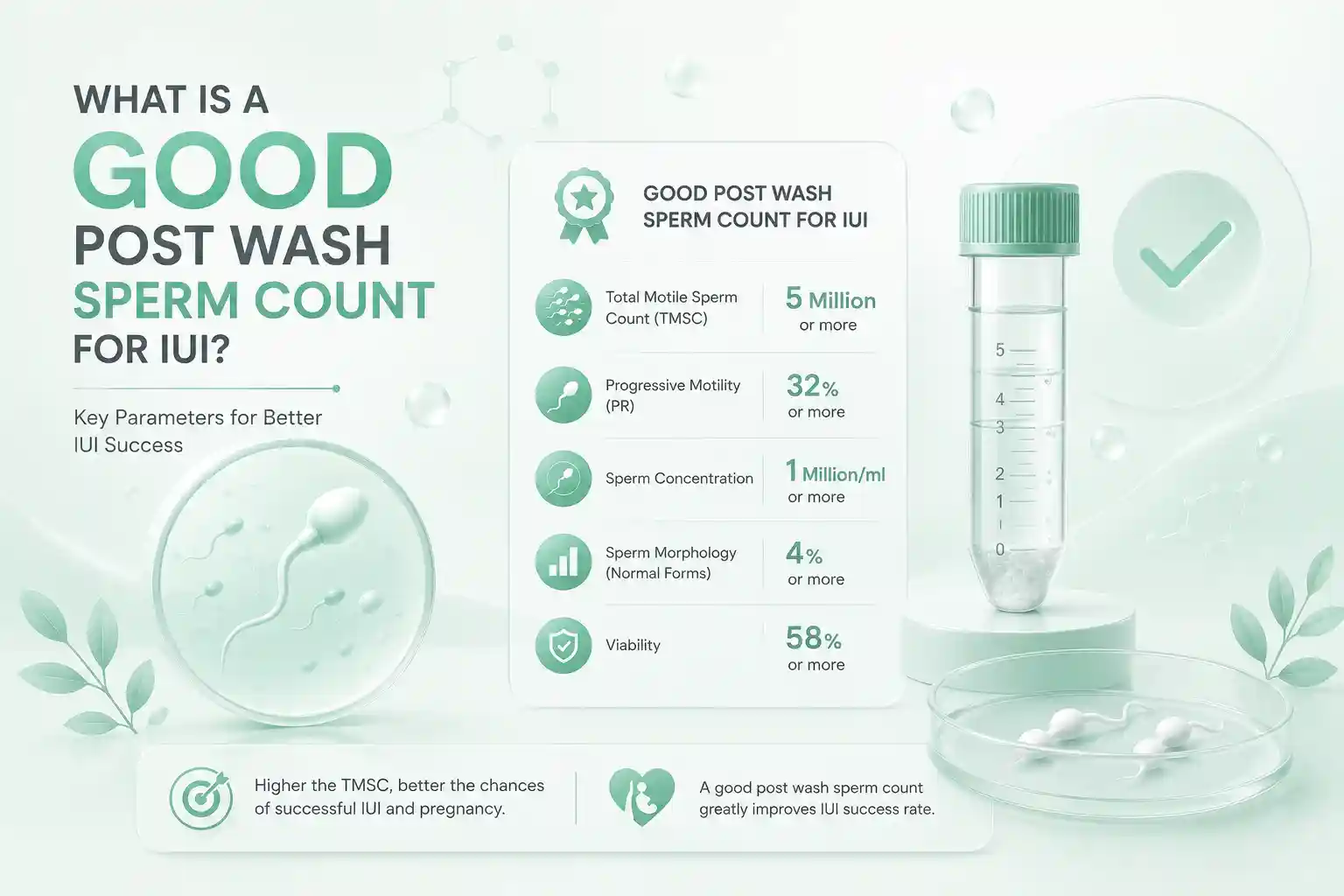
A good post wash sperm count for IUI is generally considered to be a total motile sperm count (TMSC) of at least 5 million, although many fertility specialists prefer 10 million or more after sperm washing because pregnancy rates may be higher with increasing numbers of motile sperm. However, successful pregnancies have also been reported with lower counts, and sperm quality, female age, ovulation timing, and the cause of infertility are all important factors.
This guide explains what is a good post wash sperm count for IUI, how sperm washing works, and what influences IUI success.
What Is Post Wash Sperm Count?
The post wash sperm count refers to the number of motile (moving) sperm remaining after laboratory processing.
During sperm washing:
- Seminal fluid is removed.
- Debris and non-motile sperm are separated.
- Highly motile sperm are concentrated.
- The prepared sperm sample is placed into the uterus during IUI.
The laboratory usually reports the post-wash total motile sperm count (TMSC) rather than simply the total sperm count.
What Is a Good Post Wash Sperm Count for IUI?
Although there is no single cutoff that guarantees pregnancy, many fertility specialists use the following general guide:
| Post-Wash Total Motile Sperm Count (TMSC) | General Interpretation |
| Less than 1 million | Lower chance of pregnancy with IUI |
| 1–5 million | Pregnancy is possible, but success rates may be lower |
| 5–10 million | Generally considered a good range for many IUI cycles |
| More than 10 million | Often considered an excellent post-wash count |
These ranges are approximate and should be interpreted alongside other fertility factors.
Why Is Total Motile Sperm Count Important?
The total motile sperm count (TMSC) is one of the most important semen parameters for IUI because only motile sperm are capable of swimming toward and fertilizing an egg.
A higher post-wash TMSC may improve the probability of fertilization, but it does not guarantee pregnancy.
How Is Post Wash Sperm Count Measured?
After sperm washing, the laboratory evaluates:
- Total motile sperm count (TMSC)
- Sperm concentration
- Progressive motility
- Morphology (shape)
- Sample volume
Your fertility specialist uses these results to determine whether IUI is an appropriate treatment.
Does a Low Post Wash Sperm Count Mean IUI Will Fail?
No. A lower post-wash sperm count does not automatically mean IUI will be unsuccessful.
Pregnancy has been achieved in some couples with lower TMSC values. However, lower counts may reduce the likelihood of pregnancy per cycle, and your fertility specialist may recommend additional IUI cycles or discuss IVF with Intracytoplasmic Sperm Injection (ICSI) if sperm numbers are significantly reduced.
Other Factors Affecting IUI Success
A good post-wash sperm count is only one part of a successful IUI cycle.
Other important factors include:
Female Age
Egg quality and ovarian reserve generally decline with increasing age, affecting pregnancy rates.
Ovulation Timing
Accurate timing of insemination relative to ovulation is essential.
Fallopian Tube Health
At least one open, healthy fallopian tube is usually required for IUI.
Sperm Quality
Motility, morphology, and DNA integrity also influence fertilization potential.
Underlying Cause of Infertility
Conditions such as unexplained infertility, ovulation disorders, endometriosis, or severe male factor infertility can affect treatment outcomes.
Benefits of Sperm Washing Before IUI
Sperm washing offers several advantages:
- Concentrates the healthiest motile sperm.
- Removes seminal plasma and debris.
- Reduces inflammatory substances.
- Improves preparation for intrauterine insemination.
- Helps optimize the quality of the inseminated sample.
Risks, Side Effects, or Limitations
Although sperm washing is a routine laboratory procedure, patients should understand that:
- A good post-wash sperm count does not guarantee pregnancy.
- Some sperm are naturally lost during the washing process.
- Female fertility factors remain equally important.
- Multiple IUI cycles may be required.
Emotional & Patient Perspective
Receiving your post-wash sperm count can feel stressful, especially if the number is lower than expected. It’s important to remember that fertility treatment outcomes depend on many variables—not just one laboratory result. A post-wash count that appears modest may still result in pregnancy, while an excellent count cannot guarantee success. Discussing your results with your fertility specialist can help you understand what they mean in the context of your overall fertility evaluation.
Tips to Optimize IUI Success
To support the best possible outcome:
- Follow your fertility specialist’s treatment plan.
- Attend all monitoring appointments.
- Maintain a healthy lifestyle.
- Avoid smoking and recreational drugs.
- Limit alcohol intake.
- Take prescribed medications as directed.
- Discuss whether additional fertility treatments are appropriate if several IUI cycles are unsuccessful.
When to See a Fertility Specialist
Consult a fertility specialist if:
- You have abnormal semen analysis results.
- You have been trying to conceive for one year (or six months if you are 35 years or older).
- You have experienced recurrent pregnancy loss.
- You have known infertility.
- You would like to discuss whether IUI or IVF is the most appropriate treatment.
If you’re wondering what is a good post wash sperm count for IUI, a post-wash total motile sperm count of at least 5 million is generally considered favorable, while 10 million or more is often regarded as an excellent range. However, successful pregnancy depends on much more than sperm count alone. Female age, ovulation timing, fallopian tube health, sperm quality, and the underlying cause of infertility all play important roles. Your fertility specialist can interpret your post-wash results and recommend the treatment plan that best fits your individual circumstances.
FAQs About What Is a Good Post Wash Sperm Count for IUI
1. What is a good post wash sperm count for IUI?
A post-wash total motile sperm count (TMSC) of at least 5 million is generally considered favorable, while 10 million or more is often regarded as an excellent count for IUI.
2. What does post wash sperm count mean?
It refers to the number of healthy, motile sperm remaining after laboratory processing (sperm washing) and prepared for insemination.
3. Can IUI work with less than 5 million post wash sperm?
Yes. Pregnancy can occur with lower counts, although the chance of success per cycle may be lower compared with higher post-wash TMSC values.
4. Why is sperm washing performed before IUI?
Sperm washing removes seminal fluid, debris, and poorly motile sperm while concentrating healthy, motile sperm for insemination.
5. Does a high post wash sperm count guarantee pregnancy?
No. A higher post-wash sperm count may improve the chance of fertilization, but pregnancy also depends on female age, egg quality, ovulation timing, fallopian tube health, and other fertility factors.
6. What happens if my post wash sperm count is very low?
Your fertility specialist may recommend repeating IUI, investigating the underlying cause of male factor infertility, or discussing IVF with ICSI if appropriate.
7. Is total motile sperm count more important than total sperm count?
Yes. For IUI, total motile sperm count (TMSC) is generally considered more clinically useful because motile sperm are needed to reach and fertilize the egg.