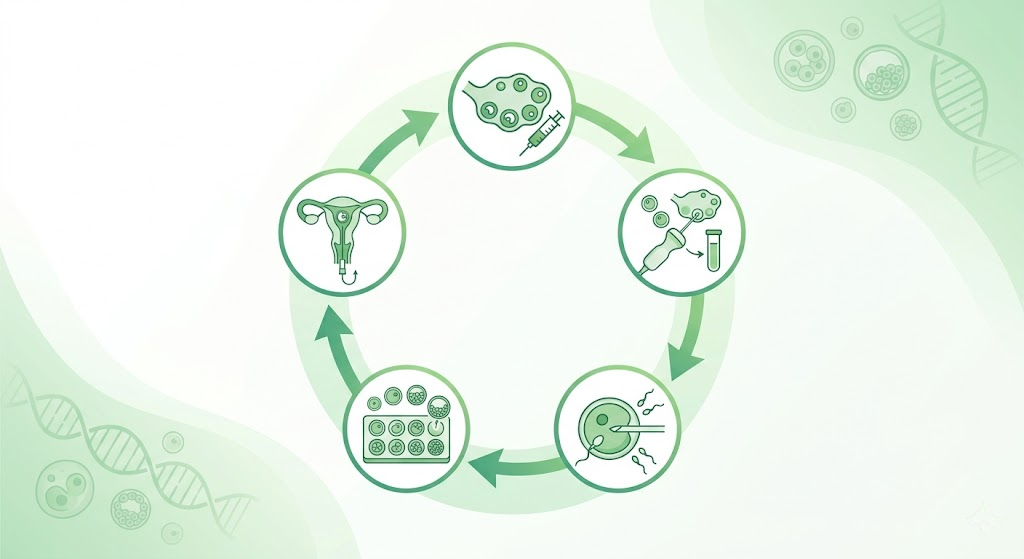
If you’re planning fertility treatment, one of the most common questions is: “What are the 5 stages of IVF?”
Understanding these stages can make the process feel less overwhelming and help you prepare for each step with confidence.
What Are the 5 Stages of IVF?
The 5 stages of IVF (In Vitro Fertilization) are:
- Ovarian stimulation
- Egg retrieval
- Fertilization
- Embryo development
- Embryo transfer
Each stage plays a crucial role in helping achieve a successful pregnancy.
Stage 1: Ovarian Stimulation
This is the first step of the IVF process.
What happens:
- Hormone injections are given for 8–14 days
- Ovaries are stimulated to produce multiple eggs
- Regular ultrasounds monitor progress
Goal: Develop multiple healthy eggs
Stage 2: Egg Retrieval
Once the eggs are mature, they are collected.
What happens:
- A minor procedure under sedation
- Takes about 15–20 minutes
- Mild cramping may occur afterward
Goal: Collect eggs safely for fertilization
Stage 3: Fertilization
The collected eggs are fertilized in a lab.
What happens:
- Eggs are combined with sperm
- Or ICSI is used if needed
Goal: Create embryos
Stage 4: Embryo Development
Fertilized eggs grow into embryos over a few days.
What happens:
- Monitored for 3–5 days
- Best-quality embryos are selected
Goal: Identify the strongest embryo
Stage 5: Embryo Transfer
A healthy embryo is placed into the uterus.
What happens:
- Quick and painless procedure
- No anesthesia required
Goal: Achieve implantation and pregnancy
What Happens After the 5 Stages of IVF?
After completing the 5 stages of IVF:
- You wait 10–14 days (two-week wait)
- A blood test confirms pregnancy
This is often the most emotional part of the journey.
Why Understanding the 5 Stages of IVF Matters
Knowing what are the 5 stages of IVF helps you:
- Feel mentally prepared
- Reduce stress and uncertainty
- Follow treatment steps correctly
- Improve overall experience
Are the 5 Stages of IVF Painful?
Most stages involve mild discomfort, not severe pain:
- Injections → slight pinching
- Egg retrieval → done under sedation
- Transfer → usually painless
Doctors ensure your comfort throughout the process.
So, what are the 5 stages of IVF? They include stimulation, egg retrieval, fertilization, embryo development, and embryo transfer—each carefully designed to maximize your chances of pregnancy.
If you’re considering IVF, consulting a fertility specialist can help you understand these stages based on your personal condition and guide you through each step with confidence.
FAQs About the 5 Stages of IVF
How long do the 5 stages of IVF take?
Typically 4–6 weeks for one full cycle.
Which stage of IVF is most important?
All stages are important, but embryo quality plays a key role.
Can IVF fail at any stage?
Yes, but doctors monitor each step to improve success.
Is embryo transfer the final stage?
Yes, followed by the waiting period and pregnancy test.
How many embryos are transferred?
Usually one or two, depending on medical advice.