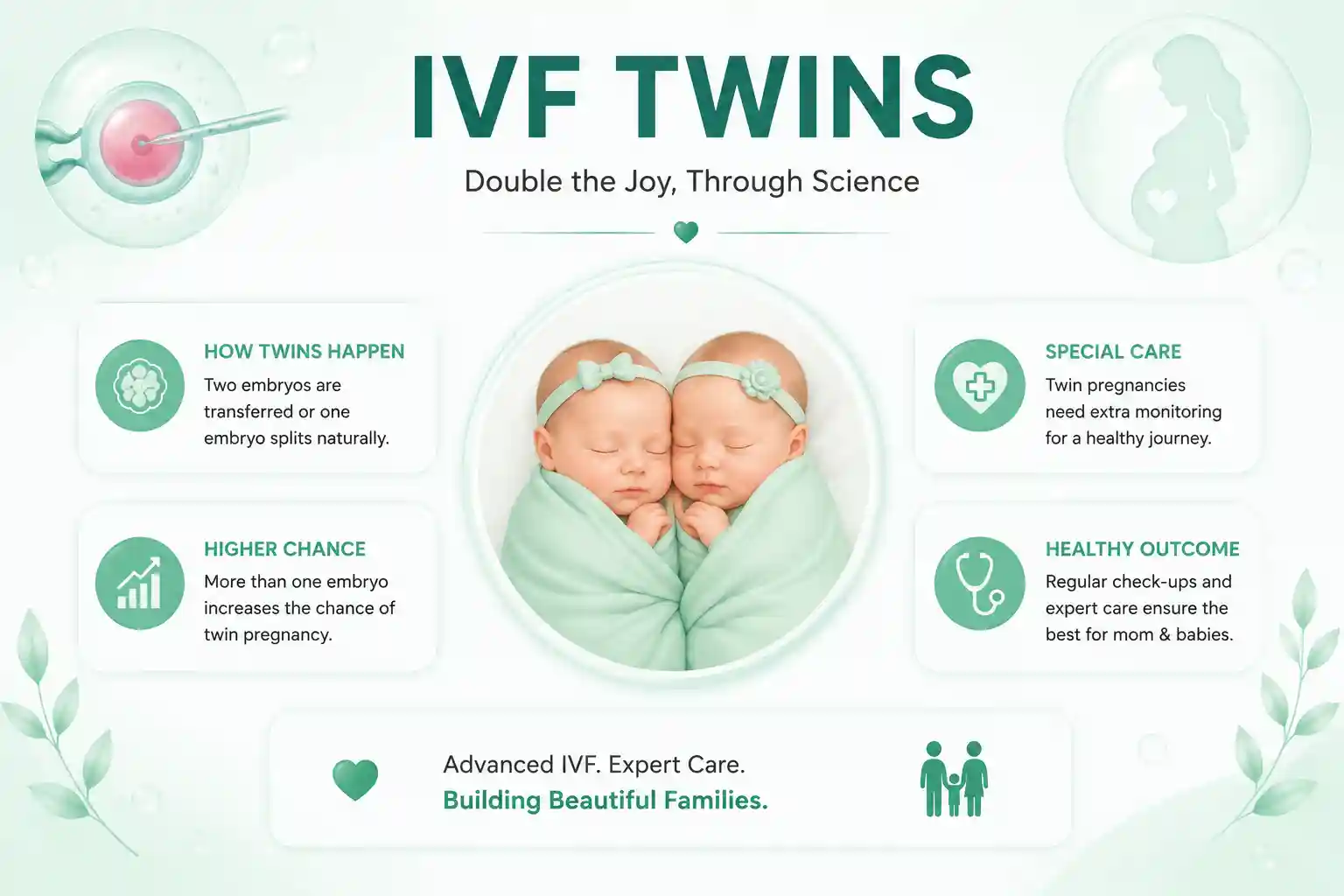
Many couples undergoing In Vitro Fertilization (IVF) are curious about the possibility of having twins. The topic of IVF twins is one of the most frequently searched fertility questions because transferring embryos during IVF can sometimes result in a twin pregnancy.
Although twin pregnancies are more common after IVF than in natural conception, advances in fertility treatment—particularly the increased use of Single Embryo Transfer (SET)—have reduced the number of multiple pregnancies. Today, fertility specialists aim to achieve a healthy singleton pregnancy whenever possible while still maximizing the chances of success.
This guide explains IVF twins, the different types of twins, how twin pregnancies occur after IVF, associated risks, and factors that influence the likelihood of twins.
What Are IVF Twins?
IVF twins refer to a twin pregnancy that occurs following an IVF treatment cycle.
Twin pregnancies after IVF can occur in two main ways:
- Two embryos implant successfully after multiple embryo transfer, resulting in fraternal (dizygotic) twins.
- A single transferred embryo divides into two embryos, resulting in identical (monozygotic) twins.
Both types are possible, although fraternal twins are generally more common when more than one embryo is transferred.
Types of IVF Twins
Fraternal Twins
Fraternal twins develop when:
- Two separate eggs are fertilized.
- Two embryos implant successfully.
- Each baby has its own unique genetic makeup.
Fraternal twins may be:
- Two boys
- Two girls
- One boy and one girl
Identical Twins
Identical twins develop when:
- One embryo is transferred.
- The embryo later divides into two genetically identical embryos.
Identical twins are always the same biological sex because they originate from the same embryo.
How Common Are IVF Twins?
The chance of IVF twins depends on several factors, including:
- Number of embryos transferred
- Maternal age
- Embryo quality
- Type of embryo transfer
- Fertility clinic policies
The use of Single Embryo Transfer (SET) has significantly reduced twin pregnancy rates while maintaining good pregnancy outcomes for many patients.
How Do IVF Twins Happen?
Twin pregnancy may occur if:
- Two transferred embryos implant successfully.
- One embryo splits after implantation.
- Two embryos are transferred and one subsequently divides, resulting in a higher-order multiple pregnancy, although this is uncommon.
The exact reason why an embryo divides into identical twins is not fully understood.
Benefits of IVF Twins
Some couples see certain advantages to having twins, such as:
- Completing family building with one pregnancy.
- Siblings growing up together.
- Potentially avoiding another IVF cycle.
However, these perceived benefits should be balanced against the increased medical risks associated with multiple pregnancies.
Risks, Side Effects, or Limitations
Twin pregnancies carry higher risks than singleton pregnancies.
Potential risks include:
- Preterm birth
- Low birth weight
- Pregnancy-induced hypertension
- Gestational diabetes
- Cesarean delivery
- Placental complications
- Increased need for neonatal intensive care
Because of these risks, many fertility specialists recommend transferring a single embryo when appropriate.
Factors Affecting the Chance of IVF Twins
Several factors influence the likelihood of IVF twins.
Number of Embryos Transferred
The greatest factor affecting twin pregnancy is the number of embryos transferred.
Embryo Quality
High-quality embryos have a greater chance of implantation.
Female Age
Age influences implantation rates and treatment planning.
Fresh vs. Frozen Embryo Transfer
Twin pregnancy rates may vary depending on the treatment protocol.
Embryo Splitting
Even after transferring a single embryo, identical twins can occasionally occur if the embryo divides.
Emotional & Patient Perspective
Many couples initially hope for twins, believing it may shorten their fertility journey or help them complete their family more quickly. While these feelings are understandable, twin pregnancies require closer medical monitoring because they are considered higher-risk than singleton pregnancies.
Discussing your goals, expectations, and medical history with your fertility specialist can help determine the safest embryo transfer strategy for your individual situation.
Tips Before Embryo Transfer
Before embryo transfer:
- Discuss the number of embryos to transfer with your fertility specialist.
- Understand the benefits of Single Embryo Transfer (SET).
- Ask about your clinic’s twin pregnancy rates.
- Follow all medication instructions carefully.
- Attend every monitoring appointment.
- Maintain a healthy lifestyle throughout treatment.
When to See a Fertility Specialist
Consult a fertility specialist if:
- You are planning IVF treatment.
- You have experienced previous IVF failure.
- You have questions about embryo transfer options.
- You would like to understand your chances of twins.
- You have concerns about pregnancy risks.
A personalized fertility consultation can help you choose the most appropriate treatment plan.
IVF twins can occur when two embryos implant successfully or when a single embryo divides into identical twins. Although IVF has historically been associated with a higher likelihood of twin pregnancy, modern fertility practice increasingly favors Single Embryo Transfer (SET) to reduce the risks associated with multiple pregnancies while maintaining good success rates. The decision regarding embryo transfer should always be individualized and made in consultation with a qualified fertility specialist, taking into account age, embryo quality, medical history, and overall reproductive goals.
FAQs About IVF Twins
1. Can IVF result in twins?
Yes. IVF can result in twins if two embryos implant successfully or if one embryo divides into identical twins.
2. Are IVF twins always identical?
No. IVF twins may be fraternal or identical, depending on how the pregnancy develops.
3. What increases the chance of IVF twins?
The primary factor is transferring more than one embryo. Identical twins can also occur after the transfer of a single embryo, although this is uncommon.
4. Is twin pregnancy after IVF high risk?
Yes. Twin pregnancies generally carry higher risks than singleton pregnancies, including preterm birth, low birth weight, and pregnancy-related complications.
5. Can a single embryo transfer result in twins?
Yes. A single embryo can occasionally divide after transfer, resulting in identical twins.
6. Why do many clinics recommend Single Embryo Transfer?
Single Embryo Transfer helps reduce the risk of twin pregnancy while maintaining good pregnancy outcomes for many patients.
7. Can IVF guarantee twins?
No. IVF cannot guarantee a twin pregnancy. Whether twins occur depends on factors such as the number of embryos transferred, embryo implantation, and whether an embryo divides naturally.