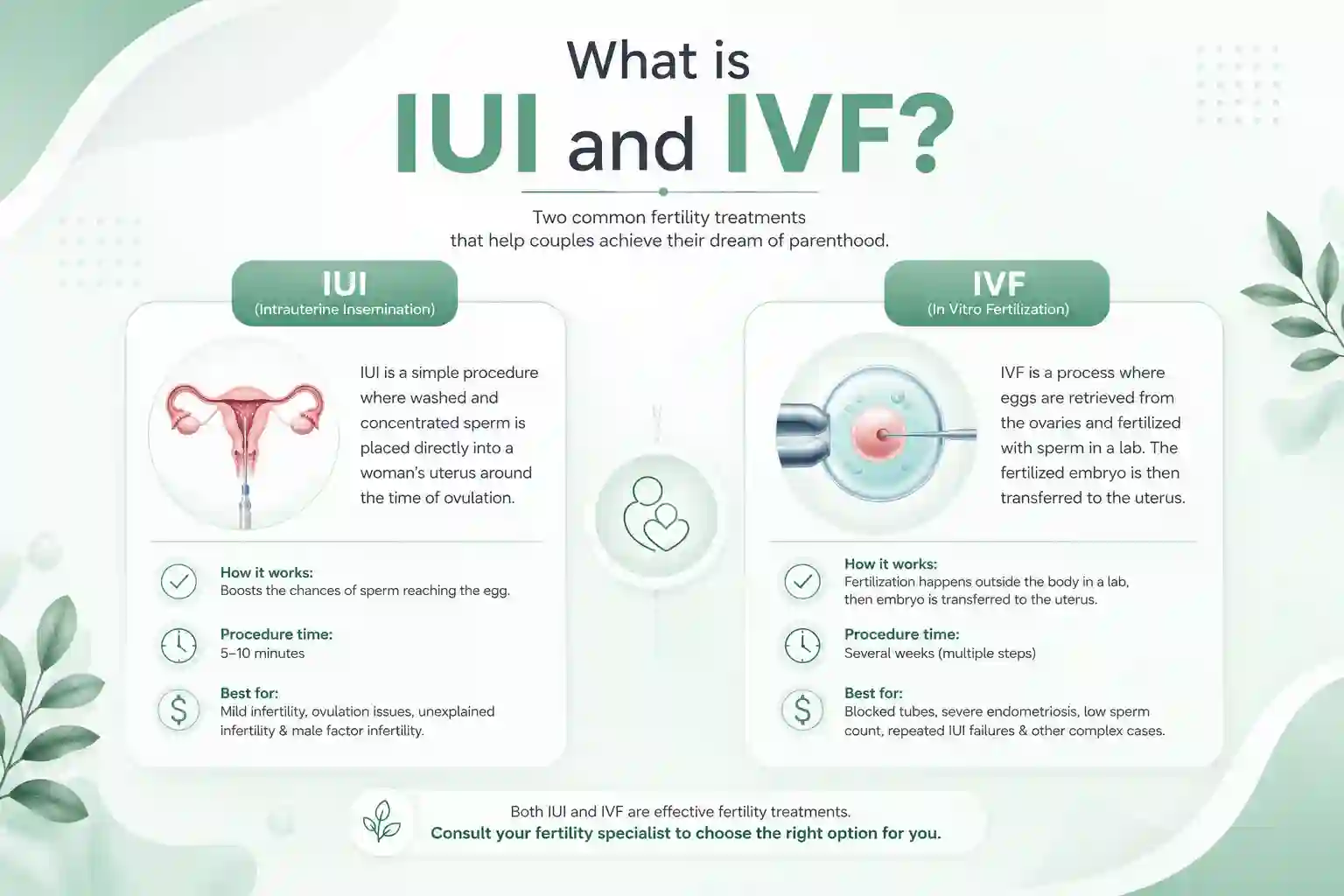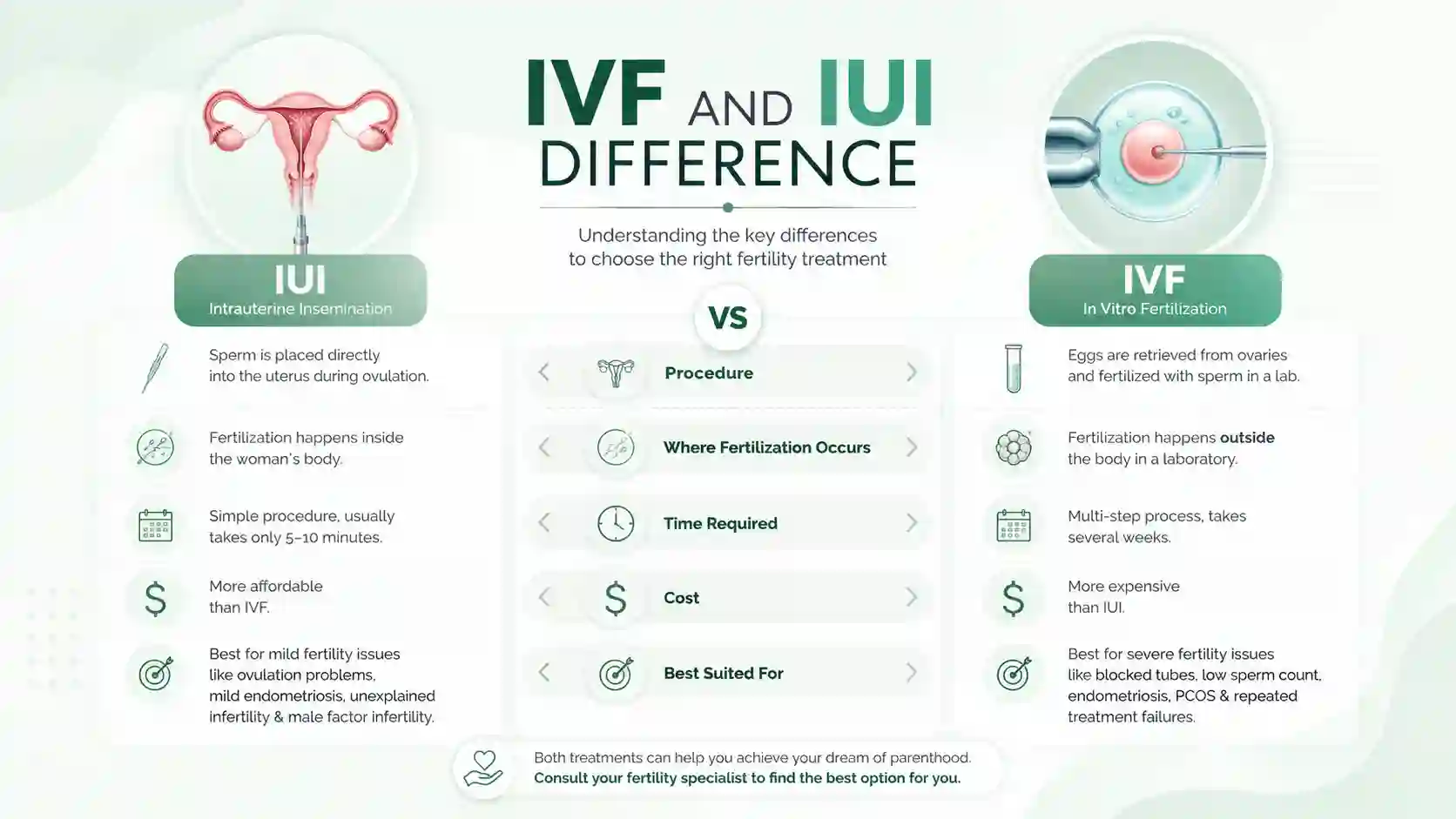
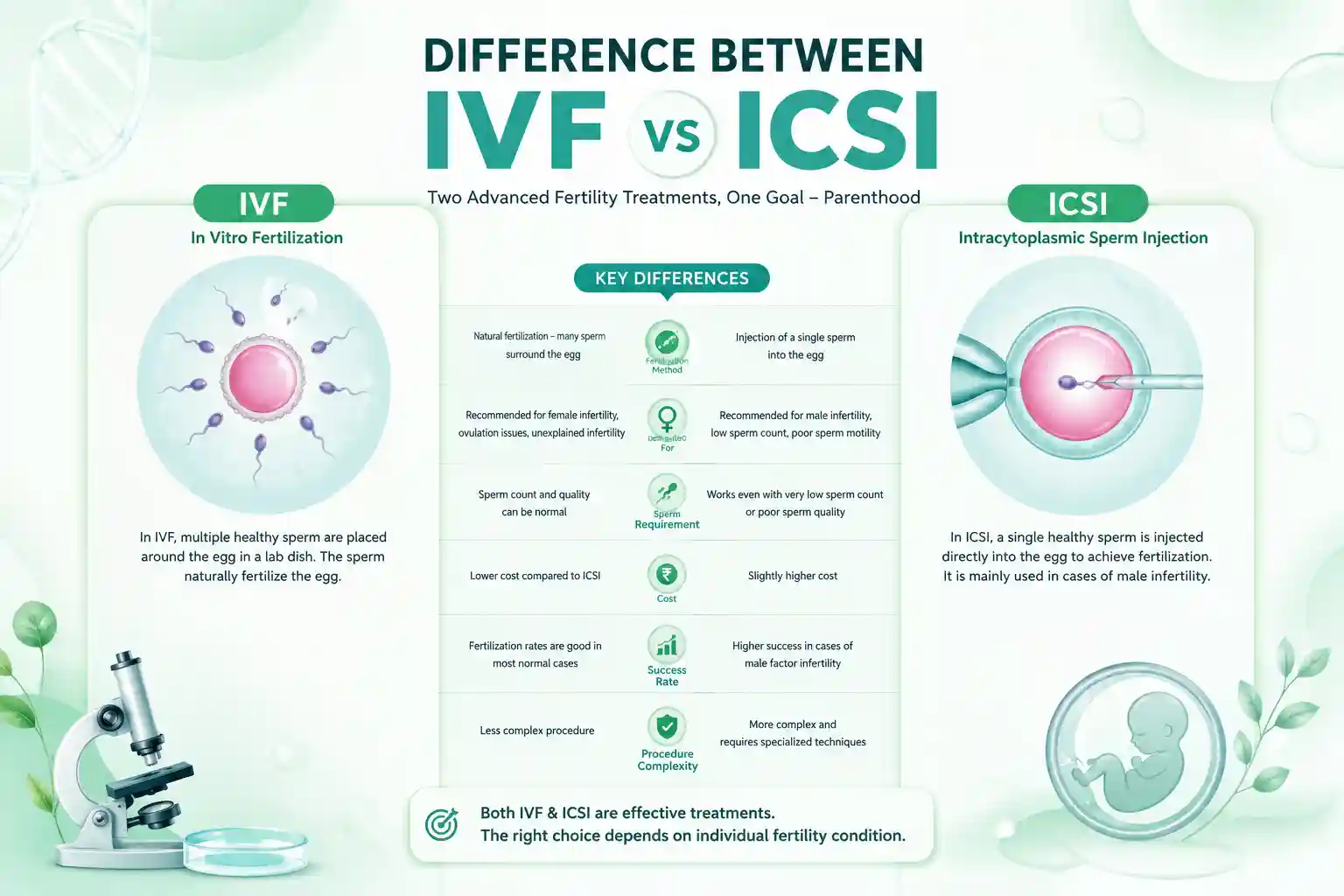
When exploring fertility treatments, many couples come across the terms IVF and ICSI and wonder how they differ. Although both procedures are forms of Assisted Reproductive Technology (ART), they use different methods to achieve fertilization.
In Vitro Fertilization (IVF) allows sperm and eggs to fertilize naturally in a laboratory dish, whereas Intracytoplasmic Sperm Injection (ICSI) involves injecting a single healthy sperm directly into a mature egg using specialized laboratory equipment.
Both treatments aim to achieve pregnancy, but the choice between IVF and ICSI depends on the underlying cause of infertility, sperm quality, previous treatment history, and recommendations from a fertility specialist.
This guide explains the difference between IVF and ICSI, how each procedure works, and when one treatment may be recommended over the other.
What Is IVF?
In Vitro Fertilization (IVF) is a fertility treatment in which:
- Eggs are collected from the ovaries.
- A semen sample is prepared.
- Eggs and sperm are placed together in a laboratory dish.
- Fertilization occurs naturally if a sperm successfully enters the egg.
- The resulting embryo develops in the laboratory before embryo transfer.
IVF relies on the sperm’s natural ability to penetrate the egg.
What Is ICSI?
Intracytoplasmic Sperm Injection (ICSI) is an advanced laboratory technique performed as part of an IVF cycle.
During ICSI:
- A mature egg is selected.
- A single healthy sperm is chosen under a microscope.
- The sperm is injected directly into the egg using a very fine needle.
- Fertilization is assessed the following day.
- The resulting embryo is cultured before transfer to the uterus.
ICSI bypasses many of the natural barriers to fertilization.
Difference Between IVF and ICSI
| Feature | IVF | ICSI |
| Fertilization Method | Egg and sperm are placed together for natural fertilization | A single sperm is injected directly into the egg |
| Number of Sperm Needed | Thousands of motile sperm | One selected sperm per mature egg |
| Laboratory Technique | Standard fertilization | Micromanipulation under a microscope |
| Best For | Normal or mildly reduced sperm quality | Moderate to severe male factor infertility and previous fertilization failure |
| Complexity | Simpler laboratory procedure | More specialized laboratory procedure |
| Cost | Generally lower | Usually higher because of the additional laboratory procedure |
When Is IVF Recommended?
IVF may be recommended for:
- Blocked fallopian tubes
- Ovulation disorders
- Endometriosis
- Unexplained infertility
- Mild male factor infertility
- Fertility preservation in selected situations
Your fertility specialist will determine whether conventional IVF is appropriate.
When Is ICSI Recommended?
ICSI may be recommended for:
- Low sperm count
- Poor sperm motility
- Abnormal sperm morphology
- Previous IVF fertilization failure
- Surgical sperm retrieval
- Certain cases involving frozen sperm
The decision is based on a comprehensive fertility evaluation.
Is ICSI More Successful Than IVF?
ICSI generally provides higher fertilization rates in couples with significant male factor infertility because it bypasses many obstacles that prevent sperm from entering the egg.
However, for couples without male factor infertility, ICSI has not consistently been shown to improve pregnancy or live birth rates compared with conventional IVF. The most appropriate treatment depends on the specific fertility diagnosis rather than assuming one method is universally better.
Benefits of IVF
IVF offers several advantages:
- Allows natural sperm selection during fertilization.
- Effective for many causes of infertility.
- Widely used worldwide.
- Can be combined with embryo freezing.
- Can be combined with genetic testing when indicated.
Benefits of ICSI
ICSI offers several advantages:
- Helps overcome severe male infertility.
- Requires only one healthy sperm per mature egg.
- Reduces the risk of failed fertilization due to sperm-related factors.
- Useful when sperm is obtained through surgical retrieval.
- Commonly used in advanced fertility centers.
Risks, Side Effects, or Limitations
Both IVF and ICSI share many of the same treatment-related risks because both involve ovarian stimulation, egg retrieval, and embryo transfer.
Patients should understand that:
- Neither treatment can guarantee pregnancy.
- Success depends on age, egg quality, embryo quality, and overall reproductive health.
- ICSI does not eliminate every cause of infertility.
- Multiple IVF or ICSI cycles may be needed in some cases.
Your fertility specialist will discuss the benefits and limitations based on your individual circumstances.
Factors Affecting Success
Several factors influence the success of both IVF and ICSI.
Female Age
Egg quality generally declines with age, affecting pregnancy rates.
Embryo Quality
Healthy embryos have a better chance of implantation.
Sperm Quality
Sperm quality is especially important when deciding between IVF and ICSI.
Uterine Health
A healthy endometrium supports embryo implantation.
Underlying Fertility Diagnosis
The cause of infertility plays a major role in determining treatment success.
Emotional & Patient Perspective
Choosing between IVF and ICSI can feel overwhelming, particularly when you’re trying to understand complex medical terminology.
Many couples worry that one treatment is automatically “better” than the other. In reality, the best approach depends on your individual fertility evaluation. Some couples achieve excellent outcomes with conventional IVF, while others benefit from ICSI because of specific sperm-related challenges.
Open communication with your fertility specialist can help you understand why a particular method is recommended and what to expect throughout treatment.
Tips Before Starting Treatment
Before beginning IVF or ICSI:
- Complete all recommended fertility investigations.
- Ask why a specific fertilization method is being recommended.
- Understand the expected benefits and limitations.
- Follow all medication instructions carefully.
- Attend every monitoring appointment.
- Discuss treatment costs and available options with your clinic.
When to See a Fertility Specialist
Consult a fertility specialist if:
- You have been trying to conceive for one year (or six months if you are 35 years or older).
- You have been diagnosed with male factor infertility.
- You have experienced previous IVF fertilization failure.
- You have blocked fallopian tubes or unexplained infertility.
- You would like personalized advice on IVF or ICSI.
A detailed fertility assessment can help determine the most appropriate treatment approach.
The main difference between IVF and ICSI lies in how fertilization occurs. In conventional IVF, eggs and sperm are placed together in the laboratory, allowing fertilization to occur naturally. In ICSI, a single healthy sperm is injected directly into each mature egg using specialized laboratory equipment. While ICSI is particularly beneficial for couples with significant male factor infertility or previous fertilization failure, conventional IVF remains an effective option for many other infertility conditions. The choice between IVF and ICSI should always be based on an individualized fertility assessment and the recommendations of a qualified fertility specialist.
FAQs About the Difference Between IVF and ICSI
1. What is the main difference between IVF and ICSI?
In IVF, fertilization occurs naturally in the laboratory after eggs and sperm are placed together. In ICSI, a single sperm is injected directly into a mature egg.
2. Is ICSI more successful than IVF?
ICSI may improve fertilization rates in cases of significant male factor infertility. For couples without male factor infertility, pregnancy and live birth rates are generally similar to those achieved with conventional IVF.
3. Why would a doctor recommend ICSI instead of IVF?
ICSI is often recommended for low sperm count, poor sperm motility, abnormal sperm morphology, previous fertilization failure, or when sperm is obtained through surgical retrieval.
4. Is ICSI more expensive than IVF?
Yes. ICSI usually costs more because it requires an additional specialized laboratory procedure.
5. Can ICSI guarantee fertilization?
No. Although ICSI can improve the likelihood of fertilization in selected cases, it cannot guarantee fertilization, embryo development, or pregnancy.
6. Do IVF and ICSI share the same treatment steps?
Yes. Both treatments involve ovarian stimulation, egg retrieval, embryo culture, and embryo transfer. The primary difference is the laboratory fertilization technique.
7. How do I know whether IVF or ICSI is right for me?
The most appropriate treatment depends on factors such as sperm quality, egg quality, previous fertility treatment outcomes, and the underlying cause of infertility. A fertility specialist can recommend the best approach after a comprehensive evaluation.