
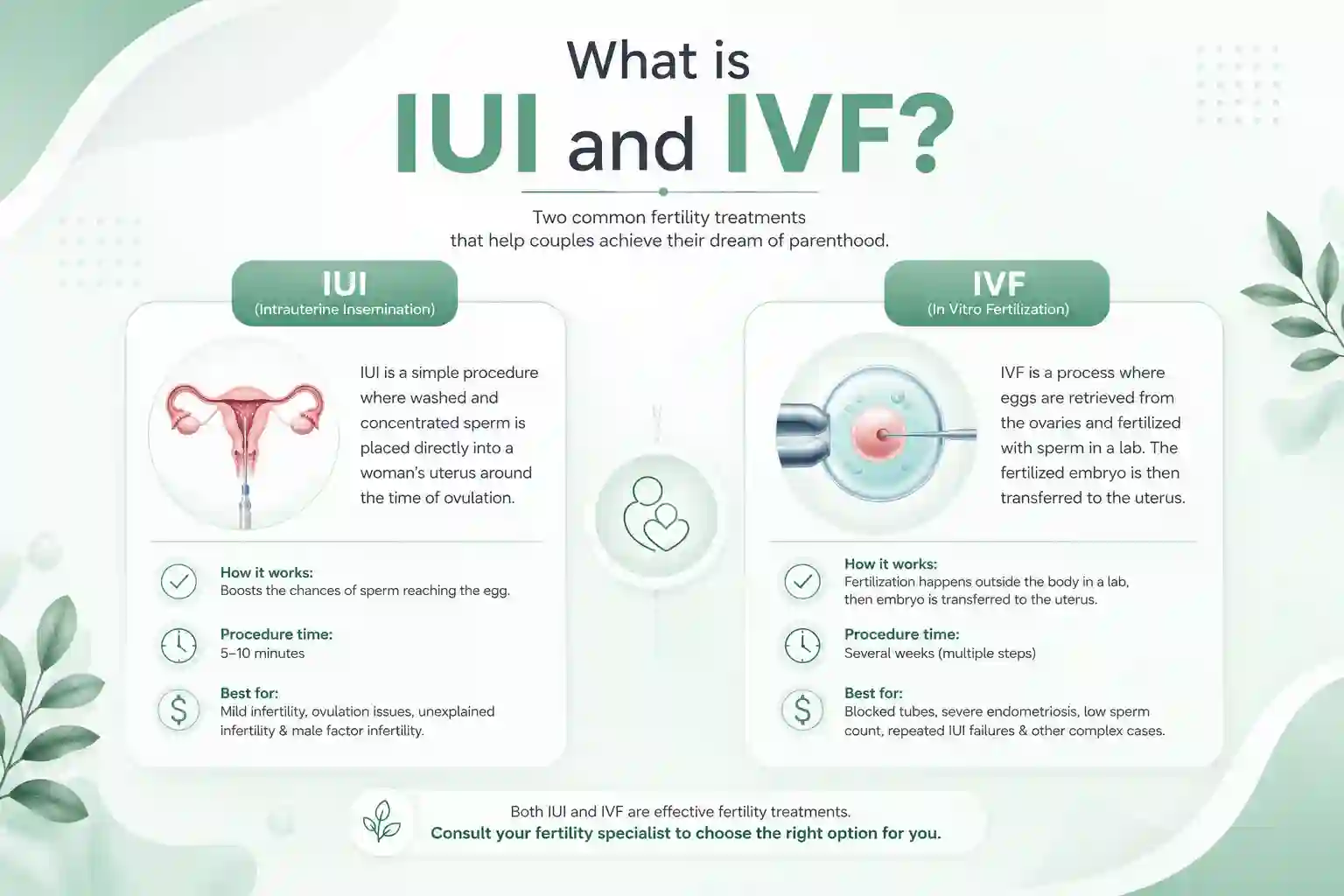

If you’re researching fertility treatments, you may be wondering what is iui and ivf and how they differ. Both are assisted reproductive technologies designed to help individuals and couples achieve pregnancy, but they work in different ways and are recommended for different fertility challenges.
IUI (Intrauterine Insemination) is a relatively simple procedure where prepared sperm is placed directly into the uterus during ovulation. IVF (In Vitro Fertilization) is a more advanced treatment in which eggs are fertilized with sperm in a laboratory before an embryo is transferred into the uterus.
Understanding how these treatments work can help you make informed decisions and have productive conversations with your fertility specialist.
What Is IUI and IVF?
What Is IUI?
Intrauterine Insemination (IUI) is a fertility treatment that increases the chances of sperm reaching and fertilizing an egg.
During the procedure:
- A semen sample is collected.
- The sperm is washed and concentrated in a laboratory.
- A thin catheter is used to place healthy sperm directly into the uterus during ovulation.
Fertilization still occurs naturally inside the fallopian tube.
What Is IVF?
In Vitro Fertilization (IVF) is a more advanced fertility treatment.
The process involves:
- Stimulating the ovaries to produce multiple eggs
- Retrieving mature eggs from the ovaries
- Fertilizing the eggs with sperm in a laboratory
- Growing embryos for several days
- Transferring one selected embryo into the uterus
Unlike IUI, fertilization occurs outside the body before embryo transfer.
Why Is Understanding What Is IUI and IVF Important?
Knowing what is iui and ivf helps patients:
- Understand available fertility treatment options
- Learn which treatment may suit their medical condition
- Set realistic expectations about procedures and outcomes
- Prepare emotionally and financially for treatment
- Discuss personalized treatment plans with a fertility specialist
Every fertility journey is unique, and the right treatment depends on individual circumstances.
How Does IUI Work?
The IUI process usually includes the following steps:
Step 1: Ovulation Monitoring
Your doctor tracks ovulation using ultrasound, blood tests, or ovulation predictor kits.
Step 2: Sperm Preparation
The semen sample is processed to separate the healthiest and most motile sperm.
Step 3: Insemination
Prepared sperm is gently placed inside the uterus using a soft catheter.
Step 4: Pregnancy Test
About two weeks later, a pregnancy test determines whether implantation has occurred.
The procedure itself usually takes only a few minutes and does not require surgery.
How Does IVF Work?
IVF includes several carefully planned stages.
Step 1: Ovarian Stimulation
Fertility medications encourage multiple eggs to mature.
Step 2: Monitoring
Regular ultrasounds and blood tests monitor follicle development.
Step 3: Egg Retrieval
Mature eggs are collected using a minimally invasive procedure.
Step 4: Laboratory Fertilization
The retrieved eggs are combined with sperm in a laboratory.
Step 5: Embryo Development
Embryos are monitored for several days before selection.
Step 6: Embryo Transfer
One carefully selected embryo is transferred into the uterus.
Step 7: Pregnancy Test
A blood test is performed approximately two weeks after embryo transfer.
Benefits of IUI
IUI offers several advantages:
- Minimally invasive
- Usually completed in one clinic visit
- No surgery required
- Little or no recovery time
- Lower treatment cost than IVF
- Often recommended as an initial fertility treatment
It may be suitable for people with:
- Mild male infertility
- Unexplained infertility
- Ovulation disorders
- Cervical factor infertility
- Use of donor sperm
Benefits of IVF
IVF provides additional options for more complex fertility conditions.
Benefits include:
- Higher pregnancy rates for many patients
- Can bypass blocked fallopian tubes
- Effective for severe male infertility
- Allows embryo freezing for future use
- May include genetic testing of embryos when medically appropriate
- Suitable for a wide range of infertility causes
Risks, Side Effects, or Limitations
Possible IUI Side Effects
Most patients experience little discomfort, but possible side effects include:
- Mild cramping
- Light spotting
- Temporary pelvic discomfort
- Rare risk of infection
Possible IVF Side Effects
IVF may involve:
- Injection-related discomfort
- Bloating
- Mild abdominal pain after egg retrieval
- Medication side effects
- Rare ovarian hyperstimulation syndrome (OHSS)
Both treatments are generally considered safe when performed by experienced fertility professionals.
Cost, Timeline, and Success Rate
One of the biggest differences between IUI and IVF is treatment complexity.
IUI
- Usually completed within one menstrual cycle
- Lower treatment cost
- Lower pregnancy rate per cycle
- Multiple cycles may be recommended
IVF
- Takes several weeks to complete
- Higher treatment cost
- Higher pregnancy rate per cycle for many patients
- May reduce the need for repeated treatment cycles in certain situations
Success depends on many factors, including:
- Female age
- Egg quality
- Sperm quality
- Underlying infertility diagnosis
- Overall reproductive health
Your fertility clinic can provide individualized success estimates based on your medical history.
Factors Affecting Results
Whether IUI or IVF is more successful depends on several factors:
- Age
- Ovarian reserve
- Egg quality
- Sperm count and motility
- Fallopian tube health
- Uterine abnormalities
- Endometriosis
- Lifestyle factors such as smoking and body weight
- Duration of infertility
A comprehensive fertility evaluation helps determine the most appropriate treatment.
Emotional & Patient Perspective
Learning what is iui and ivf is often just the beginning of a fertility journey.
Many patients experience hope, uncertainty, excitement, and stress throughout treatment. While medical procedures are important, emotional well-being also plays a significant role.
Seeking support from your partner, family, friends, support groups, or a fertility counselor can help you navigate the emotional aspects of treatment.
Remember that fertility treatment is highly individualized, and needing one treatment over another does not reflect your chances of ultimately building a family.
Tips Before Starting IUI or IVF
Before beginning treatment:
- Schedule a complete fertility evaluation.
- Ask your doctor to explain every step of the process.
- Maintain a balanced diet and healthy lifestyle.
- Avoid smoking and excessive alcohol.
- Take medications exactly as prescribed.
- Prepare emotionally by understanding that treatment may take more than one cycle.
- Keep communication open with your healthcare team.
Being informed can make the treatment experience less stressful and more manageable.
When to See a Fertility Specialist
Consider consulting a fertility specialist if:
- You have been trying to conceive for 12 months without success (or six months if you’re over age 35).
- You have irregular or absent ovulation.
- You have known fallopian tube disease.
- Your partner has abnormal semen analysis results.
- You have recurrent pregnancy loss.
- You have endometriosis or other reproductive health conditions.
Early assessment can help identify the most suitable fertility treatment and improve your chances of pregnancy.
Understanding what is iui and ivf is an important first step when exploring fertility treatment options. IUI is a simpler, less invasive procedure that helps sperm reach the egg naturally, while IVF is a more advanced treatment where fertilization occurs in a laboratory before embryo transfer.
The right treatment depends on factors such as age, fertility diagnosis, medical history, and personal goals. A fertility specialist can recommend the most appropriate approach based on your individual needs and help guide you through your fertility journey with personalized care.
FAQs About What Is IUI and IVF
1. What is IUI and IVF?
IUI is a fertility treatment that places prepared sperm directly into the uterus, while IVF fertilizes eggs with sperm in a laboratory before transferring an embryo into the uterus.
2. Which is better, IUI or IVF?
Neither treatment is universally better. The best option depends on the cause of infertility, age, reproductive health, and your fertility specialist’s recommendations.
3. Is IVF more successful than IUI?
For many patients, IVF has higher pregnancy rates per cycle, especially in cases of advanced maternal age or more complex infertility.
4. Is IUI painful?
Most patients experience only mild discomfort or cramping during IUI, and the procedure is generally well tolerated.
5. How long do IUI and IVF treatments take?
An IUI cycle is usually completed within one menstrual cycle, while an IVF cycle generally takes several weeks from ovarian stimulation to embryo transfer.
6. Who is a good candidate for IUI?
IUI is often recommended for mild male infertility, unexplained infertility, ovulation disorders, cervical factor infertility, or the use of donor sperm.
7. When is IVF recommended instead of IUI?
IVF may be recommended for blocked fallopian tubes, severe male infertility, diminished ovarian reserve, advanced maternal age, certain genetic conditions, or when previous IUI cycles have not resulted in pregnancy.