
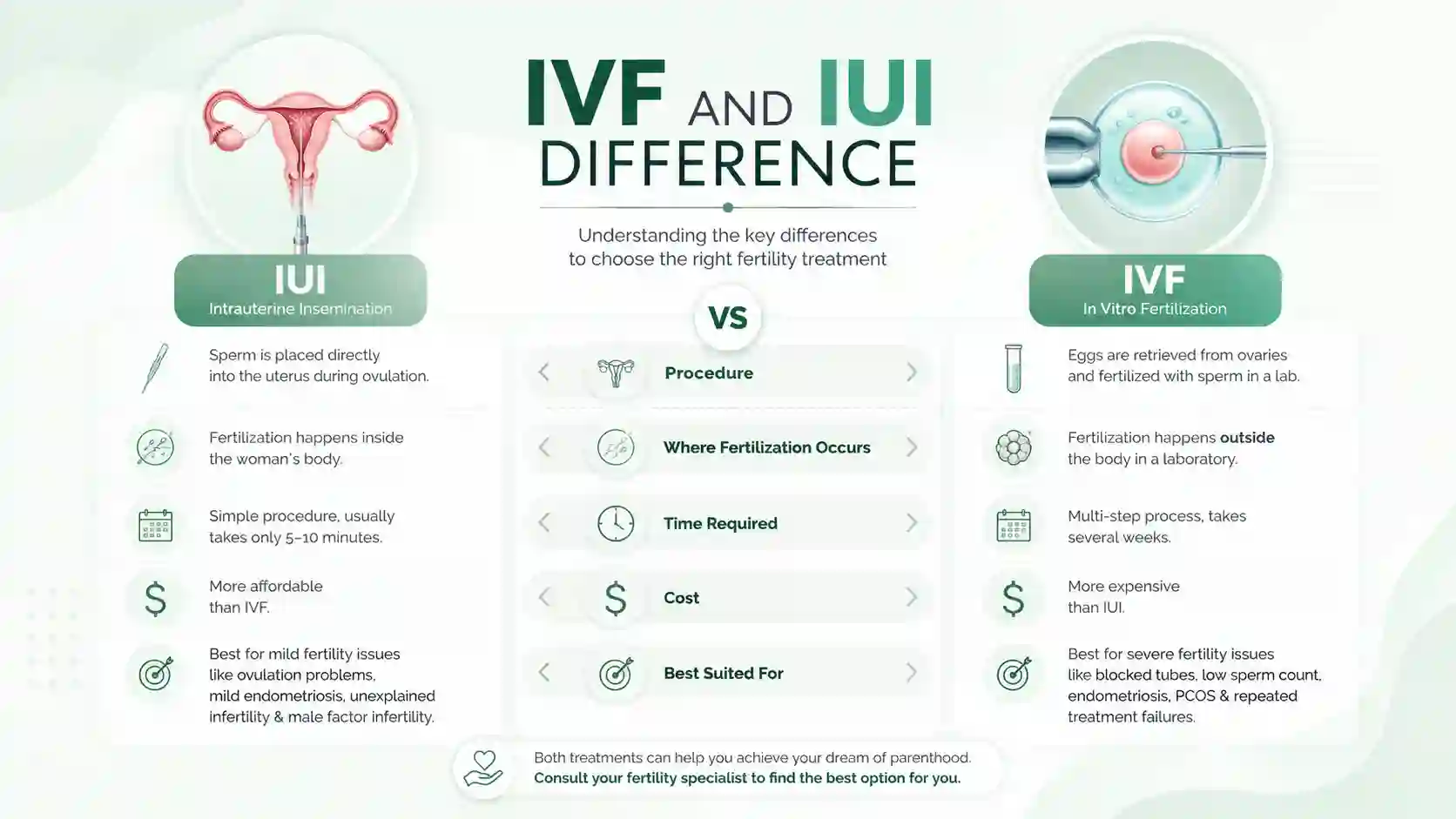

If you’re exploring fertility treatments, one of the first questions you’ll likely ask is about the ivf and iui difference. While both treatments are designed to help people achieve pregnancy, they differ significantly in how they’re performed, their success rates, costs, and who they’re best suited for.
IUI (Intrauterine Insemination) is a less invasive and more affordable treatment that places prepared sperm directly into the uterus during ovulation. IVF (In Vitro Fertilization) is a more advanced procedure in which eggs are fertilized with sperm in a laboratory before the resulting embryo is transferred into the uterus.
Understanding these differences can help you have a more informed discussion with your fertility specialist and choose the treatment that best matches your medical needs and family-building goals.
What Is IVF and IUI Difference?
The ivf and iui difference refers to how each fertility treatment helps achieve pregnancy.
What Is IUI?
Intrauterine insemination (IUI) is a procedure that places washed, concentrated sperm directly into the uterus around the time of ovulation. Fertilization still occurs naturally inside the body.
What Is IVF?
In vitro fertilization (IVF) involves stimulating the ovaries to produce multiple eggs, retrieving those eggs, fertilizing them with sperm in a laboratory, and transferring one or more embryos into the uterus.
The biggest difference is where fertilization happens:
- IUI: Inside the body (fallopian tube)
- IVF: Outside the body (laboratory)
Why Is Understanding the IVF and IUI Difference Important?
Knowing the ivf and iui difference helps patients:
- Understand available fertility treatment options
- Set realistic expectations
- Compare costs and success rates
- Choose the most appropriate treatment based on their diagnosis
- Avoid unnecessary delays in effective treatment
The best option depends on age, fertility history, medical conditions, and the underlying cause of infertility.
How Do IUI and IVF Work?
How IUI Works
The IUI process generally includes:
- Monitoring ovulation
- Collecting a semen sample
- Washing and preparing the sperm
- Inserting the sperm into the uterus using a thin catheter
- Waiting for natural fertilization to occur
The procedure usually takes only a few minutes.
How IVF Works
IVF involves several additional steps:
- Ovarian stimulation with fertility medications
- Monitoring follicle growth
- Egg retrieval under sedation
- Fertilization in the laboratory
- Embryo development
- Embryo transfer into the uterus
- Pregnancy testing about two weeks later
An IVF cycle generally takes several weeks from start to finish.
IVF and IUI Difference at a Glance
| Feature | IUI | IVF |
| Fertilization | Inside the body | In the laboratory |
| Procedure | Minimally invasive | More complex |
| Surgery Required | No | Egg retrieval procedure |
| Anesthesia | Usually not needed | Often used for egg retrieval |
| Treatment Time | A few days to two weeks | Several weeks |
| Cost | Lower | Higher |
| Success Rate per Cycle | Generally lower | Generally higher |
| Number of Clinic Visits | Fewer | More |
| Best For | Mild infertility | Moderate to severe infertility |
Benefits of IUI
IUI may be recommended because it:
- Is less invasive
- Costs significantly less than IVF
- Requires little recovery time
- Usually does not require anesthesia
- Is often the first fertility treatment offered
- Can be combined with fertility medications
Benefits of IVF
IVF offers several important advantages:
- Higher pregnancy rates for many patients
- Useful for blocked fallopian tubes
- Effective for severe male infertility (often with ICSI)
- Allows embryo freezing for future pregnancies
- Enables genetic testing of embryos when medically appropriate
- Can overcome several complex fertility problems
Risks, Side Effects, or Limitations
IUI Risks
Possible side effects include:
- Mild cramping
- Light spotting
- Small risk of infection
- Multiple pregnancy risk if fertility medications are used
IVF Risks
Possible risks include:
- Ovarian hyperstimulation syndrome (OHSS)
- Procedure-related discomfort after egg retrieval
- Multiple pregnancy if multiple embryos are transferred
- Emotional and financial stress
- Medication side effects
Both procedures are generally considered safe when performed by experienced fertility specialists.
Cost, Timeline, and Success Rate
One of the biggest ivf and iui difference considerations is cost and success.
IUI
- Lower treatment cost
- Shorter treatment cycle
- Lower pregnancy rate per cycle
- Multiple cycles are often recommended
IVF
- Higher upfront cost
- Longer treatment process
- Higher pregnancy rate per cycle for many patients
- May reduce the number of treatment cycles needed in some cases
Success rates vary based on:
- Female age
- Egg quality
- Sperm quality
- Cause of infertility
- Embryo quality (for IVF)
- Overall reproductive health
Your fertility clinic can provide personalized success estimates based on your individual situation.
Factors Affecting Treatment Results
Several factors influence whether IUI or IVF is more likely to succeed.
These include:
- Female age
- Duration of infertility
- Ovarian reserve
- Egg quality
- Sperm count and motility
- Fallopian tube health
- Uterine abnormalities
- Endometriosis
- Lifestyle factors such as smoking and obesity
A fertility evaluation helps determine which treatment offers the best chance of pregnancy.
Emotional & Patient Perspective
Choosing between IUI and IVF can feel overwhelming.
Many patients begin with IUI because it is simpler and less expensive. Others may be advised to proceed directly to IVF based on their age or fertility diagnosis to maximize their chances of success.
It’s important to remember that fertility treatment is both a medical and emotional journey. Open communication with your healthcare team and emotional support from loved ones or counselors can make the process more manageable.
Every fertility journey is unique, and needing IVF instead of IUI—or vice versa—is not a reflection of personal success or failure.
Tips for Choosing Between IUI and IVF
When considering the ivf and iui difference, discuss these questions with your fertility specialist:
- What is the underlying cause of infertility?
- How does age affect my treatment options?
- What are my chances of success with each treatment?
- How many IUI cycles should I try before considering IVF?
- What are the financial implications?
- Are there medical reasons to skip IUI and proceed directly to IVF?
The right treatment plan should be individualized based on your medical history, goals, and preferences.
When to See a Fertility Specialist
Consider consulting a fertility specialist if:
- You have been trying to conceive for 12 months (or six months if you’re over age 35).
- You have irregular or absent ovulation.
- You have known fallopian tube disease.
- Your partner has abnormal semen analysis results.
- You have recurrent pregnancy loss.
- You have been diagnosed with endometriosis or diminished ovarian reserve.
Early evaluation can help identify the most appropriate treatment and avoid unnecessary delays.
Understanding the ivf and iui difference is an important step in making informed fertility decisions. While IUI is a less invasive, lower-cost option that works well for certain infertility conditions, IVF is a more advanced treatment with higher success rates for many complex fertility challenges.
There is no single treatment that’s best for everyone. The ideal choice depends on factors such as age, reproductive health, infertility diagnosis, and personal preferences. A fertility specialist can help you determine the approach that offers the best chance of building your family.
FAQs About IVF and IUI Difference
1. What is the main IVF and IUI difference?
The main difference is that IUI places sperm inside the uterus for natural fertilization, while IVF fertilizes eggs in a laboratory before transferring an embryo to the uterus.
2. Is IVF more successful than IUI?
In many cases, yes. IVF generally has higher pregnancy rates per treatment cycle, especially for older patients or those with more complex infertility.
3. Is IUI less expensive than IVF?
Yes. IUI typically costs much less than IVF because it involves fewer medications and simpler procedures.
4. Can I try IUI before IVF?
Many patients begin with IUI if they have mild infertility. However, some medical conditions may make IVF the more appropriate first option.
5. Which treatment is more invasive?
IVF is more invasive because it includes ovarian stimulation, egg retrieval, and laboratory fertilization. IUI is a simple outpatient procedure.
6. How many IUI cycles should I try before IVF?
The number varies depending on age and diagnosis. Many fertility specialists reassess treatment if pregnancy has not occurred after several well-timed IUI cycles.
7. Who is a better candidate for IVF instead of IUI?
IVF is often recommended for people with blocked fallopian tubes, severe male infertility, significantly reduced ovarian reserve, advanced maternal age, or infertility that has not responded to simpler treatments.